


AI Solutions for Small Businesses: Moving From Hype to Measurable ROI
Artificial intelligence is everywhere right now, which is exactly why it can feel confusing and honestly, a little exhausting. For most owners, the question isn’t “Should I use AI?” It’s “Which AI solutions for small businesses will actually save time, reduce costs, or improve service in a way I can measure?” If you’ve ever tested an AI tool, felt a burst of excitement, and then wondered how it fits into real daily work, you’re not alone.
The businesses that get real ROI from AI aren’t chasing every new trend. They’re choosing one repetitive, high friction workflow, putting guardrails around it, and tracking results. AI becomes valuable when it removes the busywork your team does every week that doesn’t move the business forward so people can focus on customers, quality, and growth.

AI Trends That Matter for Small Businesses Right Now
A lot of AI headlines are written for big tech companies to push their agenda, not for businesses with lean teams and limited time. The trends that actually affect SMBs are much more practical. The biggest shift is that AI is being embedded inside tools you already use email, documents, CRM systems, ticketing platforms, and accounting software. That means “AI adoption” might not require a brand new system. It might be as simple as turning on a feature in a platform you’re already paying for, provided your data permissions and security are set up properly.
Another major trend is the move from standalone chatbots to “copilots.” Instead of opening a separate AI chat window and asking a question, copilots work where your team already spends time: in inboxes, in meeting notes, in project tools, and in customer records. When AI lives within your workflow, it becomes less of a novelty and more of a productivity lever. If you’re in Microsoft 365, Microsoft’s overview of Copilot capabilities is a helpful reference for what’s possible across email, meetings, files, and chat: https://learn.microsoft.com/en-us/copilot/microsoft-365/
The third trend is that business search is becoming conversational. Teams increasingly want to ask questions like, “What did we promise this customer?” or “Summarize the last 30 days of support issues,” and get answers based on internal documents. This is powerful, but it also raises the importance of organizing data and tightening access so the right people see the right information.

Where Measurable ROI From AI Usually Comes From
When people talk about AI ROI, they might think it makes a brand new stream of revenue. That can happen, but in small businesses, ROI usually shows up faster in a different way: efficiency, consistency, and speed. In practice, the most common wins are time saved, fewer errors, faster turnaround, and better follow through.
Think of it like if AI saves an employee 30 minutes a day, that doesn’t just reduce labor. It reduces context switching, shortens cycle times, and increases capacity without hiring. If it helps a customer service team respond faster and more accurately, you may see fewer escalations and higher retention. If it improves internal documentation and reduces repeated questions, your team spends less time reinventing the wheel.
The key is to treat ROI like a math problem, not a vibe. Before you roll out any AI solution, decide what you will measure response time, time per task, backlog size, rework rate, quote turnaround time, meeting follow up completion, or another metric that truly matters to your business. If you don’t measure it, you won’t know if you improved or just changed.
AI Solutions for Small Businesses That Tend to Pay Off Quickly
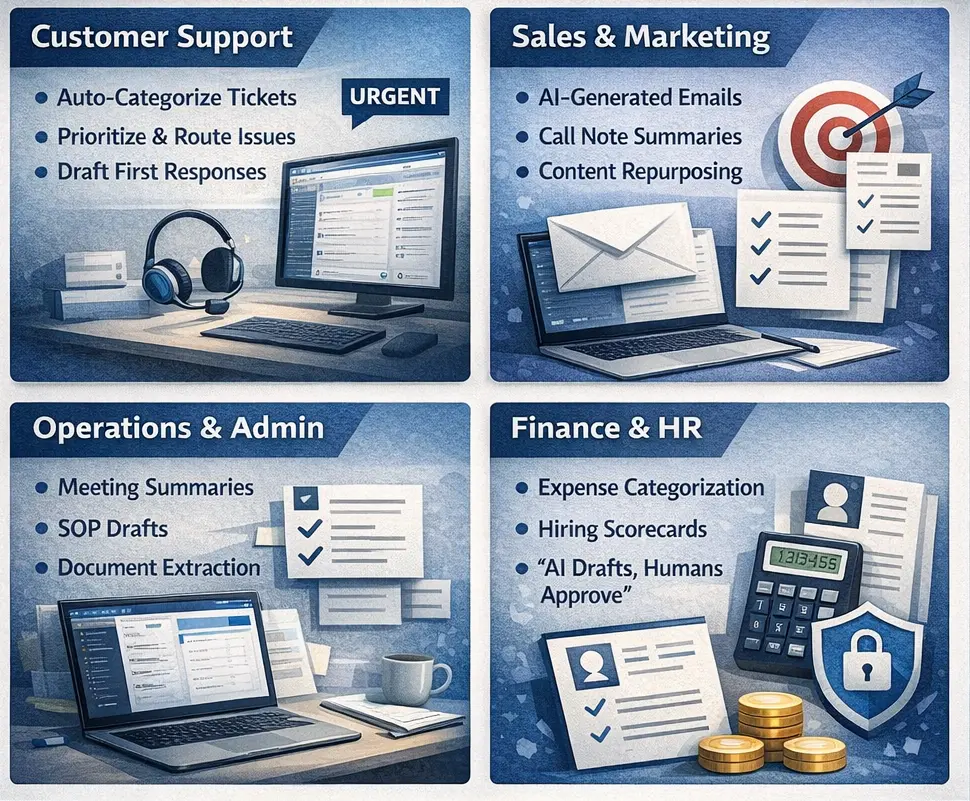
The fastest wins usually come from workflows that happen every day and don’t need complex custom development. Customer support is a classic example. AI can help categorize incoming tickets, identify urgency, route issues to the right person, and draft a first response that your team can refine. Even if the AI isn’t perfect, starting part way is often much faster than starting from zero, especially when your team is dealing with repetitive questions.
Sales and marketing also tend to find gains quick, not because AI replaces relationship building, but because it speeds up the admin work around it. AI can draft follow up emails using CRM notes, turn call notes into a structured proposal outline, and repurpose one piece of content into multiple formats. This helps teams show up consistently without burning hours on writing and formatting.
Operations and administration are another strong fit. AI is increasingly useful for summarizing meetings, drafting SOPs, extracting key fields from documents, and turning messy notes into clean internal documentation. For many small businesses, the “quiet” ROI is that fewer tasks fall through the cracks because follow ups, checklists, and next steps are captured more reliably.
Finance and HR can benefit too, as long as you’re cautious with sensitive data. AI can help categorize expenses, draft internal explanations, create hiring scorecards, and standardize onboarding checklists. In these areas, the best approach is often “AI drafts, humans approve,” especially for anything that affects payroll, compliance, or employee records.
What You Can Do For Free to Start Using AI Safely
You don’t need a big budget to learn what’s useful. You do, however, need a plan so experimentation doesn’t turn into chaos. A simple first step is using AI for drafts rather than final answers. Start with low-risk tasks like rewriting internal announcements, brainstorming email subject lines, summarizing a publicly available transcript, or creating meeting agendas. This builds confidence without exposing sensitive information.
Another free aspect is building a small prompt bank your team can reuse. Most employees will either overuse AI in risky ways or underuse it because they’re not sure what to ask. A shared set of prompts like “Summarize this meeting into action items,” or “Draft a customer update using this structure” helps people use AI consistently and safely.
If you want a values based reference for responsible AI use that’s easy to understand, the OECD AI Principles are a solid overview: https://oecd.ai/en/ai-principles. You don’t need to turn it into a formal program on day one, but it’s a helpful context for thinking about fairness, transparency, and accountability.
Risks With Implementing AI as a Small Business
AI is not “plug and play” in the way people sometimes assume. The biggest risk for SMBs is not Skynet, it’s accidental exposure of sensitive information due to messy permissions. If everyone in your company can access everything “because it’s easier,” an AI tool that searches and summarizes internal content can surface the wrong file to the wrong person. AI doesn’t magically create new permissions, but it makes information easier to discover, which changes your risk profile.
Another common risk is hallucinations AI generating confident answers that are incorrect. This is especially dangerous when outputs go directly to customers, appear in financial decisions, or influence contractual language. The solution is straightforward: require human review for anything customer-facing or high-stakes, and make it normal to verify outputs against source material.
A third risk is what they call a “shadow AI” where employees quietly paste sensitive content into free tools because they’re trying to be efficient. This is rarely malicious, it’s usually a sign you haven’t provided an approved, safe option. A clear policy and training help, but the best fix is giving your team a sanctioned toolset with guardrails.
Finally, there’s the security and compliance angle. Depending on your industry, customer data may be regulated or contractually restricted. It’s worth aligning your security approach to a practical framework like the NIST Cybersecurity Framework, which lays out clear steps around identifying, protecting, detecting, responding, and recovering: https://www.nist.gov/cyberframework.

A Simple 30 Day Plan to Get a ROI
If you want measurable ROI, start with one workflow, not ten. In week one, choose a single process that happens often, wastes time, and has a measurable outcome. Ticket triage, meeting follow ups, proposal drafting, and onboarding tasks are all common candidates. The process should be contained enough that a small team can pilot it without disrupting the entire business.
In week two, baseline your current performance. Measure how long tasks take today, how big the backlog is, or how often follow ups are missed. At the same time, set basic guidlines what data is allowed, where human approval is required, and who owns the rollout. This is also the moment to clean up any obvious permission issues in the data sources the AI will touch.
In week three, implement and train with real examples. Use scenarios from your actual business so the team can see immediate relevance. Save prompts and templates that work, and remove ones that create confusion.
In week four, compare results to your baseline. If you improved, expand carefully to the next workflow. If you didn’t, adjust or stop. A controlled no is a win too, because it prevents wasted time and tool sprawl.
Build the Foundation so AI Doesn’t Become Fragile
One reason AI disappoints is that it gets layered onto unstable systems. If devices are inconsistent, permissions are messy, and processes are undocumented, AI can amplify the disorder. Before you scale AI, focus on fundamentals like centralized identity, strong access controls, standardized device management, clean file organization, and basic governance around who can enable new tools.
Essentially, AI solutions for small businesses are worth it when they’re practical, measurable, and supported by solid security fundamentals. Start with one workflow, track a real metric, and treat AI like any other business system that needs governance. The upside is real but it’s earned through clarity and discipline, not hype.
If you want help identifying a high ROI starting point and rolling it out safely, Lighthouse Integrations can support you with an AI readiness check and a practical pilot plan. Contact us for a Free 30-Minute Consultation today.


